
“Going young” does not mean “getting dumb.”
Having spent 11 out of my 15 years in radio at AM stations, I can tell you that everyone who works there is hyper aware of “the demos.” As in audience demographics. The word that describes who listens to your station, where they live, and how old they are.

Let’s listen to AM radio!
Advertisers covet listeners and viewers between the ages of 25-54. The reasoning is that people inside that age group have yet to make lifetime brand decisions and can be persuaded by advertising. It’s a helluva spread, because someone born in 1990 is not the same as someone born in 1961. There has been a great deal of debate about the amount of money available in adults 25-54. Maybe a more lucrative demographic is 35-64, or 45-70. 55 might have seemed old in the 1970s, but in 2015 people between the ages of 55-70 are either still working, recently retired, or empty nesters with lots of disposable money to burn. But that debate has yet to alter the perception in the media buying community that 25-54 is the way to go.
Them’s the rules.
On top of that, it’s good business to cultivate another generation of listeners who will replace the older listeners who have tuned out for good.
For years, news/talk radio has been considered an “older” format. The reasons are sociological and technological.
Sociological: You are more likely to turn to news/talk radio around the time new music turns from “really cool” to “really noisy.” In search of alternatives on the radio dial, people turn to news/talk because it’s more relevant at that point in life. In other words, the average “younger listener” will be in their late 30’s or early 40’s.
Technological: As discussed in the previous post, there are whole generations of Americans who are totally unfamiliar with AM radio. As a result, there’s only so much you can do to stave off father time.
There’s a cottage industry of consultants and experts within the radio industry who try to sell the secret to attracting a younger audience to an AM, heritage news/talk station that traditionally has attracted older people. I don’t claim to have the answers, but I have learned a few things along the way.
I learned those lessons by making mistakes.
The Number One rule of spoken word radio, in my experience, is live where the audience lives. That is, try to have a conversation on the air that would sound like a conversation that would take place in the living room of your target audience. When I first started doing talk radio at WGN in 2010, I approached it with the belief that it was the listener’s job to find me. If I was interesting, funny, or insightful, people would tune in. It’s a very self-indulgent way of thinking, because I assumed that everything I said was interesting, funny, or insightful.
Nothing could be further from the truth. If I had the chance to do it again, I would flip that relationship around. As the host, it was my job to find the listener, and in order to do that I would have to work extra hard to find out what’s interesting in their life.
In some ways, that’s easier than ever before. For example:
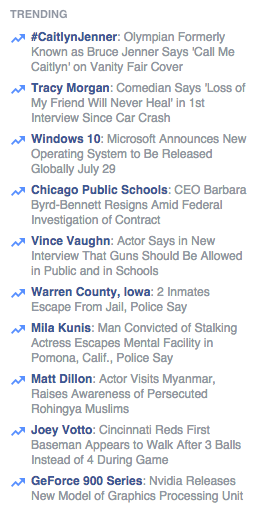
Facebook is here to help.
Facebook and Twitter have a list of trending topics which are updated by the minute. No, they shouldn’t take the place of show prep. But they do give you a good idea of where your audience’s head is at. There’s also the risk of pandering – as evidenced by the number of TV stories about whether the Charlie Charlie Challenge, popular on Twitter, was bad for your kids (answer: it isn’t).
Avoid trying to sound like “the cool guy.” The “cool guy” goes to the hippest restaurants, knows the hippest people, and has the most famous friends. The cool guy will also go the extra mile to prove to you how cool he or she is (the “cool guy” is non-gender specific).
Here’s the problem: only the “cool guy” is impressed with the “cool guy.” Everyone else is too busy with their own lives to be impressed with some person on the radio. Even so, far too much radio real estate is devoted to describing social occasions that have no relevance to the listener’s life.
Another “cool guy” trap is the segment on the trendy nightspot. I fell into this trap several times. I thought that if I invited the owner of a Lincoln Park nightclub or a hot restaurant, 20 somethings would immediately ditch their media habits and listen to AM radio. It didn’t happen. However, I did send a message to the existing audience that I didn’t value their time or attention.
Assuming that a “younger listener” can be defined as someone in their 40’s, the hip nightclub does not exist in that person’s life. The ideal younger listener to a news/talk station probably lives in the suburbs, has kids, and has the opportunity to go on a date with their spouse or significant other once every two months. The hip restaurant in the city might as well be on Mars. A restaurant segment that would resonate with the audience would involve a place that is close to where the audience lives.
This is not an unorthodox concept. The show “Check, Please!” on WTTW in Chicago is popular because it features restaurants from all over the region. The show succeeds because someone turns on Channel 11, sees the restaurant down the street, and says “that’s in our town!” “A show about restaurants” isn’t interesting in and of itself. “A show about restaurants that a near me” is interesting. “Check, Please!” does more than profile the Lincoln Park restaurant du jour.
There’s also a belief that younger listeners can be attracted by hosts taking a deliberately provocative take on current events. The Hot Take was silly when Morton Downey, Jr. did it 30 years ago, and it sounds even more hacky today. The presentation is incredibly tone-deaf, especially when heard through the ears of internet-savvy listeners who can hear a troll a mile away.
It also indicates a lack of respect for the audience. “We can make any money off of old people, and kids today are so stupid they can only respond to obnoxious people saying horrible things.” Respect their intelligence.
The generation that is aging into talk radio (people born between 1975-1985) watched 9/11 happen, fought in wars in Iraq and Afghanistan, and tried to find a job and a house in the worst economic crisis since the Great Depression. In a different time and place, they are the subject of a book by Tom Brokaw. Instead, we treat them like bizarre creatures from the Planet Millenia.
Connections with listeners aren’t made through an insightful comment or funny line. They are made when the listener thinks the broadcaster understands them. Call it the “I thought I was the only one!” principle. There are a million ways to connect with the audience. For example, why not speak to their anxieties? I’m a week away from turning 35. I’m married. I have a young daughter. I lost my job. I was looking for a house. I can promise you that those four issues occupy all of my mental energy. If I was hosting a show, I would try to tailor topics to the person who is looking for a house, having the debate over a spouse leaving work to take care of a child, looking for work, etc. You’re telling someone that they are not alone.
Are they hard and fast rules? No, they are simply helpful guidelines brought about by years of trial and error (mostly error). Will they bring about results over time? Nope. There’s only so much you can do on AM. But technology changes. The need for relevant spoken word content does not.
 Rob Hart Media