
Sticking up for severe weather coverage…..
As a longtime radio newsie, it’s hard to turn off the severe weather gene. During my five years at WTMJ in Milwaukee, severe weather seemed to find me. I was the nighttime news anchor, and for whatever reason heavy thunderstorms had a tendency to roll into southeast Wisconsin after 7:00.
It happened so often that the severe weather coverage plan was burned into my brain.
Get the watch on, get the warning on, start wall-to-wall coverage in the event of a tornado warning or report of a tornado on the ground.
Call utilities, call law enforcement, take phone calls from eyewitnesses.
Yes, we would get phone calls from disgruntled listeners who would say the ever popular “It’s summer in the Midwest, of course it’s raining!” But I always felt that we were fulfilling the mission of the radio station’s license – passing along life-saving information to people inside the listening area.
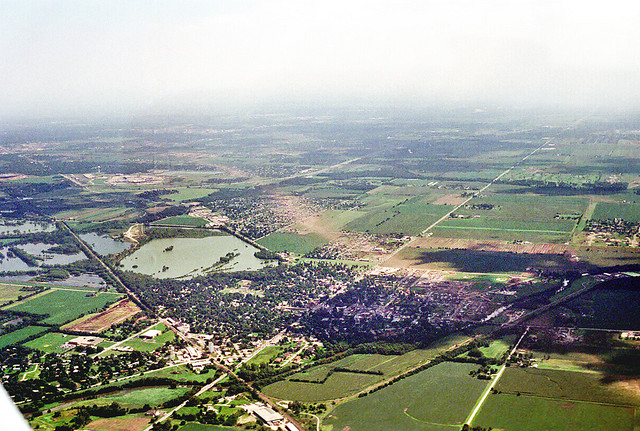
Plainfield, 1990
Last night, in lieu of watching yet another horrendous John Danks start (why did the White Sox give him that contract?!), I followed the progress of the massive severe thunderstorm as it cut it’s way across Illinois. The massive wall of red was headed for the Chicago area. The storms had already spawned tornadoes in central Illinois. It could very well do the same as it entered the Chicago suburbs. This August marks the 25th anniversary of the Plainfield tornado. In the weather community, it remains a painful memory.
Lives were lost because of a lack of adequate warning.
The storm’s arrival in Chicago also coincided with an increasingly rare occurence – a Cubs game on WGN-TV. As the storm rolled into the counties just southwest of the Chicago metro area (for all intents and purposes, the “Chicago metro area” starts in Will County), WGN went wall to wall with severe weather coverage. Cubs fans, looking forward to another night of waxing poetic over Kris Bryant’s swing, took to social media to register their outrage.
They felt the WGN storm coverage was unnecessary given the distance of the storm to Chicago. They felt it was redundant. They felt it didn’t merit taking away from TV coverage of the game. WGN, via its Twitter account, stuck up for the coverage, saying that coverage of dangerous weather trumped coverage of the game.
There are a couple of factors at play here:
1- Our general inclination to distrust TV news. Local TV news is loaded with so much ridiculous hype that we assume that severe weather coverage is another extravagance. It’s Kent Brockman territory.
Severe weather is an actual news event that merits a sense of urgency.
2- The ability of a TV station to respond to severe weather. If a severe thunderstorm was bearing down on Chicago in 1979, WGN would not have interrupted the Cubs game. It would have run a crawl along the bottom of the screen. There might have been a cut-in during a commercial break. TV stations finally have the staffing and the technology to pull off wall-to-wall coverage. Even as late as the 1980’s, TV station weather maps were hand drawn by the art department.
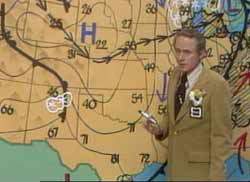
Harry Volkman
3- The importance of weather coverage to a TV newscast. During the “happy talk” era of TV news in the 1970’s, the weather guy was the clown. The sports guy was deadly serious. In Milwaukee, a hand puppet named Albert the Alleycat delivered the weather on WITI-TV (One of Albert’s co-workers was a young meteorologist from U-W Madison named Tom Skilling)
John Coleman, the weather forecaster on Channel 7’s “Eyewitness News” recorded a novelty record.
The sports department couldn’t goof around for a reason that could not be acknowledged: the gambling community (and the organized crime that kept it afloat) relied on absolutely accurate sports scores.
That changed in the 1980’s. TV news consultants made big money conducting audience perception surveys. From coast to coast, the consensus was loud and clear: we want weather coverage. The TV weather goofs retired and replaced by certified broadcast meteorologists. The AMS seal told viewers that they were getting their information from a scientist, not a designated goofball.
4- The migration of sports to designated sports channels. WGN could run all 162 Cubs games because there wasn’t much else available in terms of local programming. Ray Rayner ran in the morning, Bozo was on at noon, and the late news ran at 9:00 or 10:00. Cubs games preempted old movies or TV reruns. Over the last 30 years, previously “independent” TV stations chased network affiliations (Fox, WB, UPN, CW) and substantially beefed up their news departments. Now, a baseball game takes lower priority compared to local news or the latest episode of “Arrow.”. A baseball game on a local broadcast channel is a throwback to an earlier time. In 2015, it doesn’t matter if the Cubs are on “cable” or “free TV.”
Your Cubs viewing experience last night was sullied by a confluence of events.
You might even call it a perfect storm.
 Rob Hart Media