
Stephen Colbert knows the way down the road less traveled.
During the dawn of the “Late Night Wars” in the early 90’s, the most common metaphor used to describe the battle, as it were, between Jay Leno and David Letterman was “Coke vs. Pepsi.” Jay is Coke. Dave is Pepsi. During Johnny Carson’s 30 year run at NBC, he didn’t have much competition in late night. As of 1993, viewers could now choose between two franchises.
The amount of choices has expanded exponentially since then. During the 1990’s, I was a devotee of Aaron Barnhart’s “Late Show News” email. It was a tipsheet that existed on a listserv (remember those?) that covered the ebb and flow of the late night shows with a level of detail that would satisfy those who had dogeared copies of “The Late Shift.” (Which I most certainly did).
“Late Show News” started around the time of Letterman’s premiere on CBS, and it continued through 1999. It charted the fracturing of the late night universe. NBC had “Tonight” and “Late Night.” CBS had “Late Show” and “Late Late Show.” Fox tried and failed with Chevy Chase. Syndicated hosts like Arsenio Hall, Rush Limbaugh, Magic Johnson, and Keenan Ivory Wayans came and went. Comedy Central’s late night offering was a panel show starring Bill Maher called “Politically Incorrect.” In 1996, it was joined by “The Daily Show,” hosted by former ESPN anchor Craig Kilborn. And on Sunday nights in the late spring/early summer, you could watch “The Larry Sanders Show” on HBO skewer the whole damn thing.
That’s the world I grew up in, and it’s hard to believe that in the past 22 years the number of late night TV choices has jumped from two to two hundred. ABC jumped into the late night comedy arena with Jimmy Kimmel. Comedy Central turned “The Daily Show” into a late night beach head. TBS has Conan O’Brien. Cartoon Network, Bravo, and other cable channels have late night shows. Local affiliates have reruns of “The Simpsons” and “Seinfeld.” And that’s before you add ESPN, streaming offerings, shows on the DVR….
The field is so crowded that “Coke vs. Pepsi” no longer applies. It’s an expressway, and when you’re on the expressway, it’s important to stay in your lane.
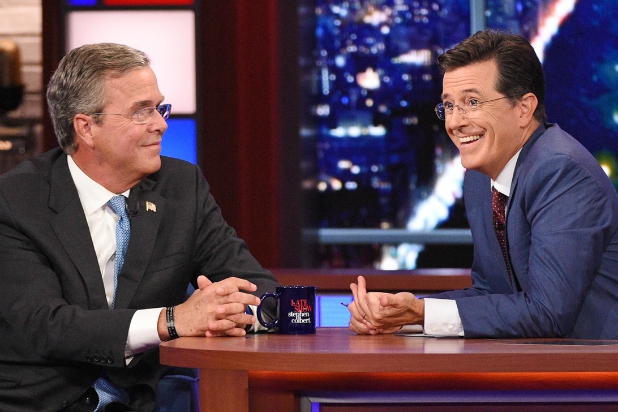
Republican Presidential candidate Jeb Bush chats with Stephen on the premiere of The Late Show with Stephen Colbert, Tuesday Sept. 8, 2015 on the CBS Television Network. Photo: Jeffrey R. Staab/CBS é2015 CBS Broadcasting Inc. All Rights Reserved
“The Jimmys,” Fallon and Kimmel know that all too well. Jimmy Kimmel brings that knowledge from morning radio, where he honed his comic persona on the legendary KROQ-FM in Los Angeles. KROQ had a format and a target audience, and his job as “Jimmy the Sports Guy” on the Kevin and Bean morning show was to make sure that he tailored his content to the people who were most likely to listen to that station. Jimmy Fallon can rely on Lorne Michaels. Since 1975, Lorne has been the master of creating comedy that is both edgy and broad. Consistency is the name of the game. They have to define what viewers should expect when they turn on their show, and then meet those expectations night after night.
What are the lanes in late night, network television? Kimmel is the blue collar guy. Ironically, he’s filling the role that was previously occupied by Jay Leno, a person Kimmel reportedly despises. The politics are middle of the road. The jokes are very much in the “dude” arena, although they are tailored just enough to appeal to the women who watch ABC’s prime time shows.
Jimmy Kimmel is the Prom King. He’s cute. The cool kids come over to his house (er, studio) to do the fun things. Every morning, the internet comes alive with viral videos produced from the previous evening’s “Tonight Show.” Jimmy Fallon will never become angry, moody, or pissed off. He’s happy to be there. He’s happy the guests are there. He’s happy you’re watching.
It would appear that Colbert has figured out his role: egghead. Like Conan O’Brien, the comedy will come out of nerd culture. Unlike Conan O’Brien, Colbert’s show will establish itself as the place to joke about and discuss politics. I felt the strongest part of Colbert’s premiere was his interview with Jeb Bush:
Jeb came loaded for bear with his campaign patter and his applause lines. Colbert gently knocked him out of his comfort zone, and the end result was an interview with a politician that was…interesting. Ever since Nixon sweated his way through that TV debate 55 years ago, political interviews on talk shows are stage managed to the point where they are no longer entertaining. Ronald Reagan was the rare politician who looked comfortable on TV, but then again, it was his home turf:
Johnny Carson, while personally liberal, was famously apolitical on TV. Plus, Reagan was his neighbor in Malibu, and they were personally friendly.
But that was 1975. This is now. If Colbert can find a way to burrow through the layers of focus-group tested rhetoric to find the human being inside, his show will be appointment TV in 2016.

