
Why it’s always important to remember the audience.
I have now worked in media for close to 16 years. In that time, I would estimate that I have received 20,000 news releases. I would also estimate that of those 20,000, I have probably read between 50 and 100. They were short, impactful, relevant, and to the point. For example, the best news release in the history of news releases was faxed (yes faxed) to the media in March of 1995. It was the news release that announced that Michael Jordan was returning to the Chicago Bulls:
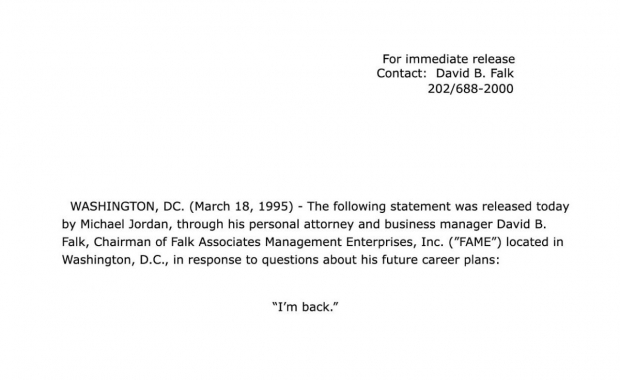
That news release could have been a full page of stats, awards, his three NBA titles, his baseball career, and his numerous endorsements. Michael Jordan was the most famous man on the planet in 1995, and there was nothing more to be said than “I’m back.” That news release literally wrote the headline.

Unfortunately, news releases rarely make international headlines. For every news release announcing the return of Michael Jordan, there are several hundred announcing the the lineup of the dog parade in the local town festival. But the most egregious cases of missed opportunities exist in the business world.
I write a news release like I would write a news story. Most interesting words first, most interesting facts up top. I want you to be captivated from Word One. That’s because I’m writing for you, the reader. I think my stuff is interesting. I want you to be interested too.
Far too many business news releases are written with one reader in mind: the boss. What they’re doing and why they’re doing it is buried under stock symbols, mission statements, and “business english.” Plain, straightforward writing is buried under a tidal wave of “deliverables,””matrices,””verticals,”and “stakeholders.” The average person, who is supposed to be dazzled by this latest initiative, will be confused.
I have a friend in public relations who used to take new hires to the TV station where she used to work. She showed them the assignment desk, which is a very cluttered space that is awash in old newspapers, coffee stains, scanners, and reams of paper that fell out of the fax machine. She pointed to the deep pile of news releases and said “that’s your competition.”
Now, news releases are delivered via email and they are deleted just as quickly as they come in. The purpose of a news release is to get a reporter or news organization interested in covering your story. If it is deleted, you have failed. It is up to the writer to make sure that a news release is worth reading.
And that takes us back to the quandary we have in newswriting. You want to make sure that a news story catches the ear of the listener. You also want to make sure that you aren’t resorting to cheap ploys to get attention. It’s a very fine line to walk. It took me years to get the hang of it and even now I’m not entirely sure that I have it right.
If you want to write a good news release, think like a newsperson. Or, failing that, be like Michael Jordan. He was good at everything, including news releases.
 Rob Hart Media